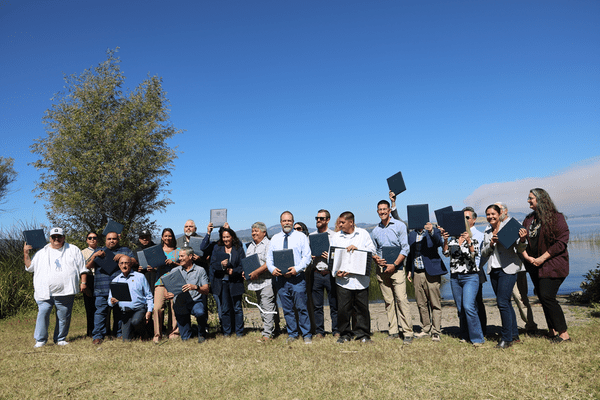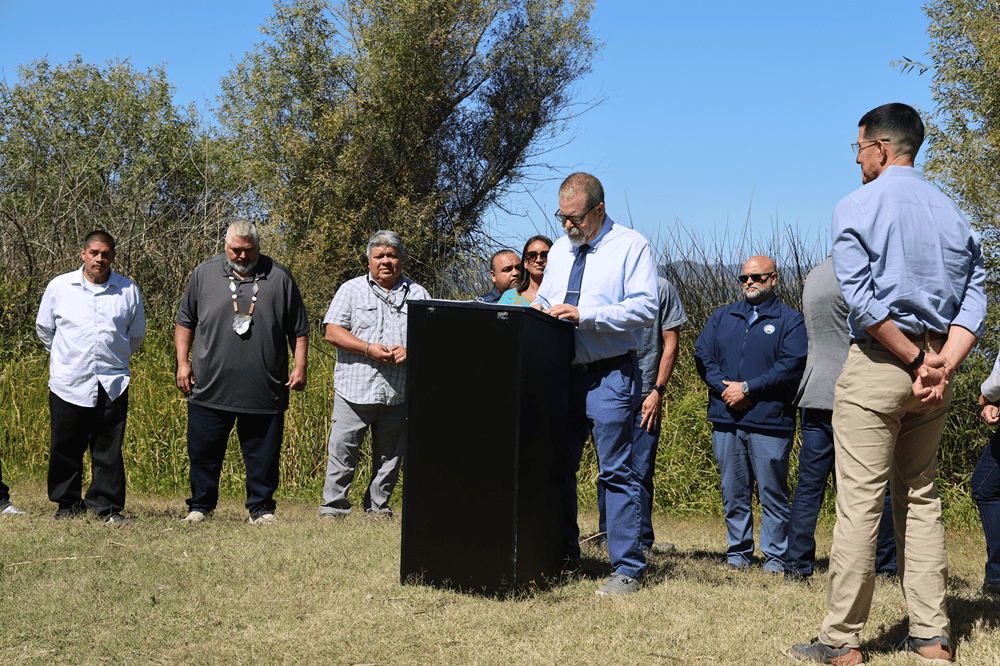
Photo Courtesy: District 4 Supervisor, Brad Rasmussen, who is Chair of both the Lake County Board of Supervisors and the Watershed Protection District, signs the Co-Management Agreement while other signatories look on
Seven Tribal Governments, 12 State Agencies, the County of Lake, two Cities, and Lake County Watershed Protection
District Sign Historic Agreement
The first of its kind in California, a co-management agreement for the Clear Lake watershed was formally signed by all parties Friday, September 11, 2026, on the rancheria of the Big Valley Band of Pomo Indians on the shoreline of Clear Lake. The official title of the agreement is “Clear Lake Watershed and Chi (Ṣátti) Memorandum of Understanding Co-Management Agreement,” which is not a legally binding agreement, but a written commitment to continue strengthening a collaborative working relationship among all parties.
“The County of Lake and the Lake County Watershed Protection District are committed to restoring and protecting the entire Clear Lake watershed – and know that we cannot do it alone. This agreement creates the foundation of commitment to work together to coordinate restoration, improve water quality for beneficial uses, recover and protect native species – especially those with cultural importance to local Tribes – and assure benefits for all,” said Brad Rasmussen, Chair of the Lake County Board of Supervisors and the Lake County Watershed Protection District.
“For thousands of years, our people have cared for the Clear Lake watershed through stewardship grounded in survival, responsibility, and traditional and spiritual knowledge,” said Flaman McCloud, Jr., Chair of the Executive Council of the Big Valley Band of Pomo Indians. “This agreement recognizes tribal governments as equal partners in shaping the future of the watershed and reflects a shared commitment to protect these lands and waters for generations to come.”
“This partnership is unique – it brings together communities and purposes that have traditionally been disparate, if not oppositional, and finds common ground where it matters most: the lake itself,” said Governor Gavin Newsom. “There are different histories, different meanings, but it’s the same water. A healthier Clear Lake means stronger, healthier communities, no matter what role the lake plays in their lives, whether it’s a cultural touchstone, an economic engine, a social anchor, or an ecological lifeline.”
The County of Lake has been formally collaborating with all Tribal Governments on the health of Clear Lake since the passage of Assembly Bill 707 (Aguiar-Curry 2017) which established the Blue Ribbon Committee for the Rehabilitation of Clear Lake with appointed members representing all seven Tribal Nations (Big Valley Band of Pomo Indians, Elem Indian Colony of Pomo Indians of the Sulphur Bank Rancheria, Habematolel Pomo of Upper Lake, Koi Nation of Northern California, Middletown Rancheria of Pomo Indians of California, Robinson Rancheria Band of Pomo Indians of California, and Scotts Valley Band of Pomo Indians of California), the University of California, Davis, the Central Valley Regional Water Quality Control Board, and the County of
Lake, which also appointed local representatives for Economic Development, Drinking Water Systems, and the Environment from community organizations.
“Restoring Clear Lake requires collaboration among Tribal representatives, all levels of government, and local communities, said Blue Ribbon Committee Chair Eric Sklar, President of the California Fish and Game Commission. “By working together and sustaining investments over time, we can improve the health of the Lake and the communities that depend on it. This agreement is an important step toward achieving that shared vision.”
Background:
What began through government-to-government consultations between the Big Valley Band of Pomo Indians and the California Department of Fish and Wildlife over the declining health and populations of the Clear Lake Hitch (lavinia exilicauda chi), a culturally important fish to area Tribes and endemic to Clear Lake, several Tribal Environmental Protection Agencies formed the Clear Lake Hitch Task Force on behalf of their respective governments with State and Local governments to hold the first summit with all government agencies in 2022 focused on the health of Clear Lake and the Clear Lake Hitch. To local Tribal Nations, the Clear Lake Hitch is referred to as “Chi” in Pomo dialects, and “Ṣátti” in Lake Miwok.
From that inaugural summit, regular Clear Lake Hitch Task Force meetings, with representatives from Tribal governments, California Natural Resources Agency (CNRA) departments and divisions, and local governments including representatives from the County of Lake and the Lake County Watershed Protection District, have been held, with an annual Clear Lake Hitch Leadership Summit. Appendix 4 of the co-management agreement includes
a Clear Lake Hitch Task Force Charter.
In 2024, the State codified Government Code Section 11019.82 (AB 1284 Ramos) that encourages CNRA to enter into co-governance and co-management agreements with federally recognized Tribal Nations to mutually negotiate, define, and allocate amongst themselves the sharing of management functions and responsibilities for a given territory, area, or set of natural resources. This government code and legislation do not apply to the County of Lake or local governments, but in the spirit of collaboration with the shared goal of restoring the health of Clear Lake and the Clear Lake Hitch, local governments also signed on to the agreement. On September 1, 2026, the Lake County Board of Supervisors and the Board of the Lake County Watershed Protection District approved, four to one, to authorize the Chair of the Board of Supervisors and the Chair of the Watershed Protection District to sign the agreement in person. District 4 Supervisor Rasmussens sits as the Chair of both the Board of Supervisors and the Chair of the Lake County Watershed Protection District, so signed on behalf of both Boards.
On January 24, 2023, the Lake County Board of Supervisors approved a Proclamation declaring a Clear Lake Hitch Emergency which is still in effect. Former Lake County District 1 Supervisor and Chair of the Middletown Rancheria Band of Pomo Indians, Jose “Moke” Simon said, “The Middletown Rancheria people are committed to continuing their longstanding stewardship of Clear Lake and all of its inhabitants. The Lake has provided for our people for thousands of years. The Hitch and all of the other resources it has provided have allowed us to coexist on this land. Today we stand with all the tribes and partners to acknowledge our responsibility to protect one of our most valuable resources.” The County of Lake Emergency Declaration can be viewed here: https://lakecountyca.gov/1976/Clear-Lake-Watershed-and-Chi-Satti-Memor#docaccess-883e85d2d2978640c13f911b92915bff
To review the agreement, visit https://lakecountyca.gov/1976/Clear-Lake-Watershed-and-Chi-Satti-Memor
For more information from the California Natural Resources Agency on this historic agreement, visit:
https://content.govdelivery.com/accounts/CNRA/bulletins/429d9e9